

The lead acid battery has been around a long time and is one of the oldest technologies still used today. It was invented back in 1859 and not much has advanced in the design, which is primarily composed of lead and sulfuric acid in a plastic housing. To put things in perspective, the first typewriter was invented in 1867; denim blue jeans in 1873; the telephone in 1876.; a record player in 1877; and the Wright Brother took to the skies in 1903 with the first fixed wing airplane!
The lithium iron phosphate chemistry battery, known as LiFePo4, or LFP, was first discovered as a better solution for many applications in 1996 but did not become commercially used until many years later due to how expensive it was, and the “common” user could not afford it. Of all the lithium battery chemistries, and there are many, the LiFePo4 chemistry is the most robust and safe available and close enough in voltage to be a replacement for a 12V lead acid battery.
ADVANTAGES:
- Upgrade Capacity and cold cranking. A lithium battery can provide more capacity than the stock lead acid battery that comes with your vehicle in the same provided space. If you have added additional accessories, such as heated gear or GPS, you might need to increase the capacity of your battery but you are limited by space. Or if you use your vehicle in extreme cold, you can upgrade your battery to a higher cold cranking amp model but will still fit in your battery box location.
- Can increase cranking in cold. When you use a lead acid battery in the cold, and assuming it is not damaged from being in extreme cold where they freeze and are no longer usable, the first start attempt you have with your snowmobile will be the best crank you will get. If it doesn’t start the first time, you are very likely not going to get it to start. However, a lithium battery is the opposite. The first crank will be the worst attempt, but if you wait 1 minute, current flows through the battery after your crank attempt and warms the cells and the next attempt will yield a much higher crank to get your snowmobile started.
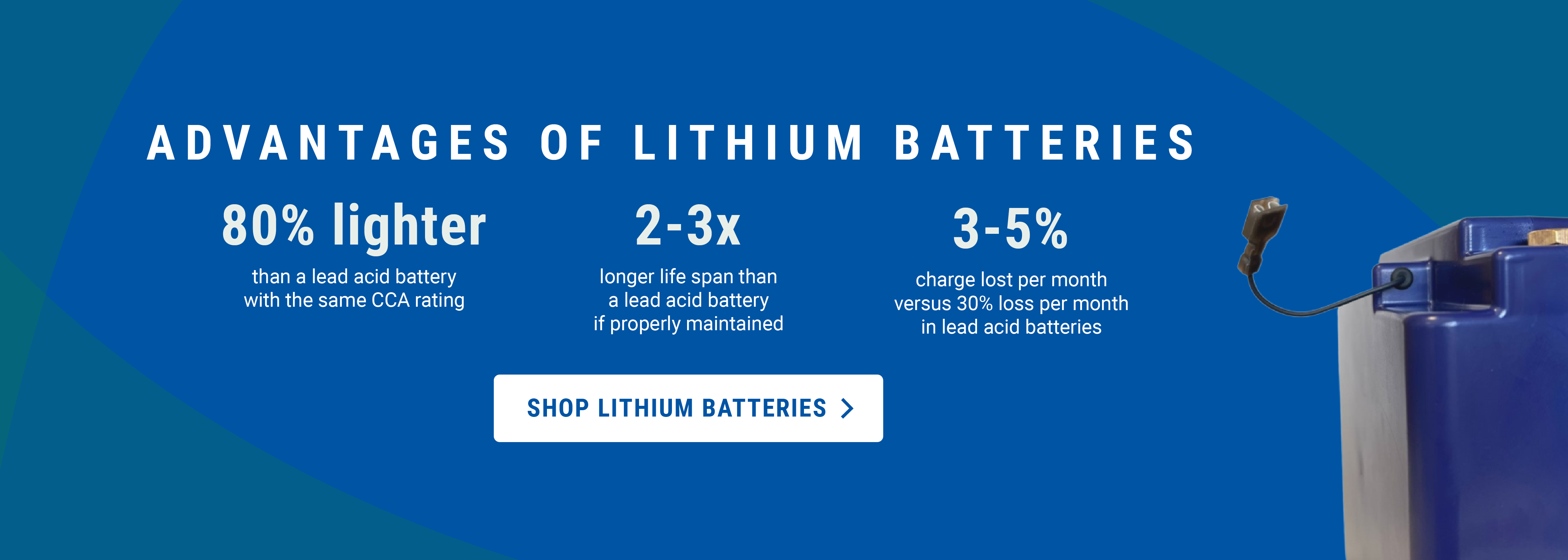
- Weight. Approximately 80% lighter than a lead acid battery with the same CCA rating. Reducing weight on the trails is always beneficial. Example, a very common Yuasa battery is the YTX20HL-BS battery used in snowmobiles. This is a 310CCA battery that weighs 15.1 pounds. The EarthX equivalent is the ETX36D, a 320CCA battery that weighs 3.9 pounds for an instant savings of 11.2 pounds. Weight savings is huge if you are a racer! Saving weight means better gas mileage, better handling, and better acceleration! The cost in light weight titanium parts is approximately $1,000 per pound, or would be over $11,000 to remove 11 pounds of weight on your snowmobile. You can do that for a fraction of the cost replacing your lead acid battery with an EarthX lithium battery.
- Higher resting voltage. A lead acid batteries starting voltage is typically about 12.4V. A LiFePo4 battery starting voltage is about 13.28V. For a starter battery, this is a huge improvement and will quickly and easily start your engine.
- Low rate of discharge. Depending on the lead acid battery, you can lose up to 30% of your charge on a battery per month. A LifePo4 battery will lose between 1-2% charge per month. This means that your LifePo4 battery can sit for an entire off season and still have plenty of power to start your engine when you are ready to ride. (if you have a vehicle that drains the battery, even when turned off, disconnect the negative battery cable for storage so you do not actively drain the battery).
- Battery management system. You can not install a BMS board inside a lead acid battery to monitor its health and prevent abuse to the battery inadvertently. EarthX has some models that even have an LED light on the battery that will “alert” you to something outside of normal. (Please see the EarthX Manual for full details on the functions the BMS provide). The number one killer of a battery is letting it discharge too low. The EarthX BMS will disconnect the drain in the event you left something on so you do not “kill” your battery.
- Environmentally friendly. The EarthX battery will not freeze, boil over, or have sulfuric acid corrosion on the terminals or on the inside on the lead plates. You will never have damage done to your vehicle by leaked or spilled acid.
- Longevity. The life span of a properly maintained LiFePo4 battery will be 2-3X longer than a lead acid battery.
Lithium Snowmobile Batteries: Lightweight, High-Performance Battery Replacement
Looking for a replacement snowmobile battery that provides more starting power, weighs less, and lasts longer than a traditional lead-acid battery?
EarthX lithium snowmobile batteries use Lithium Iron Phosphate (LiFePO4) chemistry to provide high cranking power, low weight, low self-discharge, and an integrated Battery Management System (BMS).
A lithium snowmobile battery can be an excellent upgrade for riders who want to reduce weight, improve starting performance, increase battery capacity, or get more reliable performance in cold weather.
EarthX offers lithium batteries for a wide range of snowmobiles and powersports applications.
What Is the Best Snowmobile Battery?
The best snowmobile battery depends on the specific snowmobile, engine, electrical system, climate, accessories, and how the vehicle is used.
When replacing a snowmobile battery, important factors include:
-
Cold cranking amps (CCA)
-
Battery capacity
-
Physical size
-
Terminal configuration
-
Weight
-
Cold-weather performance
-
Charging-system compatibility
-
Service life
-
Self-discharge rate
-
Battery management and protection
For riders looking for a lightweight, high-performance snowmobile battery, EarthX LiFePO4 lithium technology offers several advantages over conventional lead-acid batteries.
EarthX lithium snowmobile batteries are designed to provide high starting power while significantly reducing battery weight.
Why Replace a Snowmobile Battery With Lithium?
A conventional lead-acid battery can be one of the heaviest components on a snowmobile.
Replacing it with a properly sized EarthX lithium battery can reduce weight while increasing starting performance.
A lithium battery can also provide advantages for snowmobiles that operate in extremely cold temperatures or sit for long periods during the off-season.
More Capacity and Starting Power in the Same Space
One advantage of lithium battery technology is the ability to provide higher performance in a similar physical footprint.
If you have added accessories to your snowmobile such as:
-
Heated riding gear
-
GPS
-
Additional lighting
-
Communication equipment
-
Other electrical accessories
…you may need more battery capacity.
Always verify the battery dimensions, terminal configuration, and electrical requirements for your specific snowmobile before purchasing.
Cold-Weather Starting Performance
Cold temperatures are one of the biggest challenges for any snowmobile battery.
Lead-acid batteries can lose significant starting performance as temperatures drop. If a conventional battery becomes deeply discharged or freezes, it can also be permanently damaged.
LiFePO4 batteries behave differently in cold temperatures.
An EarthX lithium battery may initially produce less available cranking power when it is very cold. However, controlled cranking attempts can warm the cells internally, increasing the available cranking power for subsequent starting attempts.
How Do You Start a Snowmobile With a Lithium Battery in Very Cold Weather?
If your EarthX battery is very cold, the first starting attempt may not provide the battery’s full available cranking power.
The starting process can warm the cells. After a short cranking attempt, allowing the battery to rest gives the cells time to warm internally.
For EarthX batteries, follow the cold-weather starting procedure in the manual for your specific battery model.
This is an important difference between lithium and lead-acid batteries in extremely cold conditions.
Important: Never repeatedly crank the starter continuously. Follow the starting and rest intervals specified for your EarthX battery.
Lightweight Snowmobile Battery
One of the biggest advantages of a lithium snowmobile battery is weight reduction.
EarthX lithium batteries can weigh approximately 80% less than comparable lead-acid batteries, depending on the battery model.
For example, the commonly used Yuasa YTX20HL-BS is rated at 310 CCA and weighs approximately 15.1 pounds.
The EarthX ETX36D is rated at 320 CCA and weighs approximately 3.9 pounds.
That represents approximately 11.2 pounds of weight savings while providing comparable starting performance.
For snowmobile racers and performance riders, removing 11 pounds from a snowmobile can make a noticeable difference.
Weight reduction can contribute to:
-
Easier handling
-
Improved acceleration
-
Less weight to carry through rough terrain
-
Potential fuel-efficiency benefits
-
Improved power-to-weight ratio
Why Is a Lightweight Snowmobile Battery So Valuable?
Reducing vehicle weight can become increasingly expensive as you replace other components with lightweight materials.
EarthX provides a relatively simple way to remove significant weight by replacing a heavy lead-acid battery with a lithium battery.
Instead of replacing multiple expensive components to remove weight, switching to a lithium battery can provide a substantial weight reduction in one component.
Higher Resting Voltage
A conventional 12V lead-acid battery typically has a resting voltage around 12.4–12.8 volts, depending on its state of charge.
A fully charged EarthX 12V LiFePO4 battery has a typical resting voltage of approximately 13.28 volts.
This higher resting voltage can provide strong electrical performance for the snowmobile’s starting system and accessories.
A higher resting voltage does not by itself guarantee that a battery will start a particular snowmobile, the battery must also have sufficient capacity and cranking capability for the engine.
Very Low Self-Discharge
Snowmobiles often spend much more time sitting than running.
A snowmobile may be used heavily during the winter and then sit for months during the off-season.
This makes battery self-discharge an important consideration.
LiFePO4 batteries have a very low self-discharge rate. EarthX batteries typically lose approximately 1–2% of their charge per month under normal conditions.
That is significantly lower than many conventional lead-acid batteries.
Can a Lithium Snowmobile Battery Sit All Summer?
A properly maintained EarthX lithium battery can retain most of its charge during extended storage because of its low self-discharge rate.
However, the snowmobile itself may continue to consume electricity even when turned off.
Electronic systems, alarms, GPS equipment, accessories, and other parasitic loads can slowly discharge a battery.
For extended storage, follow EarthX storage recommendations. If the snowmobile has a parasitic electrical drain, disconnecting the negative battery cable can prevent the vehicle from slowly draining the battery.
We recommend charging your EarthX Battery every 6 months when not in use.
Never store a lithium battery in a deeply discharged condition.
Built-In Battery Management System
A major difference between an EarthX lithium battery and a conventional lead-acid battery is the integrated Battery Management System (BMS).
The BMS monitors the battery cells and provides electronic protection against conditions that can damage lithium cells.
Depending on the EarthX model, BMS functions can include protection against:
-
Overcharging
-
Over-discharging
-
Excessive cranking
-
Excessive temperature
-
Short circuits
-
Cell imbalance
Some EarthX batteries also include an LED indicator that can provide information about battery status or certain fault conditions.
Why Is a BMS Important in a Snowmobile Battery?
One of the most common ways to damage a rechargeable battery is allowing it to become excessively discharged.
An EarthX BMS can disconnect the battery from the load when necessary to help protect the cells from excessive discharge.
The BMS is an important part of what makes an EarthX lithium battery different from simply replacing lead-acid cells with lithium cells.
No Liquid Sulfuric Acid
EarthX LiFePO4 batteries do not contain the liquid sulfuric acid found in conventional flooded lead-acid batteries.
That means you don’t have to worry about liquid acid leaking or spilling onto your snowmobile.
EarthX lithium batteries do not:
-
Leak liquid sulfuric acid
-
Require adding water
-
Sulfate like lead-acid batteries
-
Boil over
-
Freeze like a conventional flooded lead-acid electrolyte
This can help protect the snowmobile’s battery compartment, terminals, wiring, and surrounding components from acid-related corrosion.
Long-Lasting Snowmobile Battery
If you’re looking for a snowmobile battery that lasts a long time, battery chemistry is an important consideration.
A properly maintained EarthX LiFePO4 battery can have a substantially longer service life than a conventional lead-acid battery.
EarthX lithium batteries are designed for long cycle life, and depending on the model and application, can provide thousands of charge/discharge cycles.
Actual service life depends on:
-
Charging-system condition
-
Battery maintenance
-
Storage conditions
-
Operating temperature
-
Depth of discharge
-
Frequency of use
-
Electrical loads
Proper maintenance is essential to getting the longest possible life from any battery
What Battery Does My Snowmobile Need?
The correct replacement battery depends on the specific snowmobile model and year.
When replacing a snowmobile battery, do not choose a battery based only on the physical dimensions.
Check:
-
Battery dimensions
-
Terminal location
-
Terminal type
-
Voltage
-
CCA requirements
-
Capacity requirements
-
Charging-system compatibility
-
Available battery-box space
If your snowmobile came with a lead-acid battery, you may be able to replace it with an appropriately sized EarthX lithium battery.
Can I Replace My Snowmobile’s Lead-Acid Battery With Lithium?
In many applications, yes.
A properly selected EarthX lithium battery can replace a conventional lead-acid snowmobile battery when the battery dimensions, electrical requirements, charging system, and starting requirements are compatible.
Lithium is particularly attractive for snowmobiles because it can provide significant weight savings and excellent starting power in a compact package.
Before replacing your battery, verify the correct EarthX model for your snowmobile.
Go to the green “CLICK HERE TO FIND WHAT BATTERY YOU NEED” to find what EarthX battery is compatible for your snowmobile.
Do Lithium Snowmobile Batteries Need a Special Charger?
EarthX lithium batteries should be charged with a charger that is compatible with LiFePO4 batteries and meets the charging requirements for the specific EarthX model.
Some modern smart chargers designed for lead-acid batteries may also be compatible, but chargers with inappropriate high-voltage desulfation, reconditioning, or pulse modes should not be used.
Always check the EarthX charging recommendations before connecting a charger.
Should I Disconnect My Snowmobile Battery During Summer Storage?
For long-term storage, disconnecting the battery can be helpful if the snowmobile has electrical systems that continue to draw power when the ignition is off.
A parasitic electrical load can drain even a lithium battery over time.
If you disconnect the battery, make sure it is stored in an appropriate environment and that its state of charge is maintained according to EarthX storage recommendations.
The most important rule is:
Do not leave your lithium battery deeply discharged for an extended period.
Can a Snowmobile Battery Freeze?
The answer depends on the battery chemistry and its state of charge.
Conventional lead-acid batteries contain a liquid electrolyte that can freeze if the battery becomes sufficiently discharged and exposed to very low temperatures.
EarthX LiFePO4 batteries do not contain liquid sulfuric acid electrolyte, so they do not have the same freezing problem associated with a discharged flooded lead-acid battery.
Frequently Asked Questions About Snowmobile Batteries
How long does a snowmobile battery last?
Battery life varies significantly depending on battery chemistry, use, storage, charging, temperature, and maintenance. A properly maintained EarthX LiFePO4 battery can provide a substantially longer service life than many conventional lead-acid batteries.
What is the longest-lasting snowmobile battery?
Long battery life depends on how the battery is used and maintained. EarthX LiFePO4 batteries are designed for long cycle life and can provide thousands of charge/discharge cycles depending on the model and application.
Are lithium batteries good for snowmobiles?
Yes. LiFePO4 lithium batteries can be particularly useful for snowmobiles because they provide high starting power with substantially less weight than comparable lead-acid batteries. Their low self-discharge rate is also beneficial for snowmobiles that sit for extended periods.
Are lithium batteries better than lead-acid for snowmobiles?
Lithium and lead-acid batteries have different characteristics. EarthX LiFePO4 batteries offer significant weight savings, high starting power, low self-discharge, long cycle life, and integrated battery management. The correct battery depends on the specific snowmobile and its electrical system.
How much lighter is a lithium snowmobile battery?
EarthX lithium batteries can be approximately 80% lighter than comparable lead-acid batteries, depending on the model. For example, an ETX36D weighs approximately 3.9 pounds compared with approximately 15.1 pounds for a Yuasa YTX20HL-BS, providing about 11.2 pounds of weight savings.
Can I leave my lithium snowmobile battery in the snowmobile all summer?
It depends on the snowmobile’s electrical system. If the vehicle has a parasitic electrical load, it can slowly discharge the battery. For extended storage, follow EarthX’s storage recommendations and disconnect the battery if appropriate.
Do lithium snowmobile batteries need a charger?
A lithium battery does not need to be continuously connected to a charger simply because it is stored. Because EarthX batteries have a very low self-discharge rate, they can retain their charge for long periods. However, if charging is necessary, use a compatible charger and follow EarthX charging instructions.
Can I use my old lead-acid battery charger with a lithium snowmobile battery?
Some modern smart chargers may be compatible, but not all chargers are appropriate for lithium batteries. Do not use chargers with inappropriate high-voltage desulfation, reconditioning, or pulse modes. Verify charger compatibility with EarthX before use.
How do I know what size snowmobile battery I need?
Start with the battery specifications recommended by the snowmobile manufacturer. Compare voltage, CCA, capacity, dimensions, terminal configuration, and charging requirements. You can then determine which EarthX model is appropriate for your application.
Upgrade Your Snowmobile Battery to EarthX Lithium
Your snowmobile battery has to work when temperatures are low, the engine is cold, and you need reliable starting power.
EarthX lithium snowmobile batteries combine LiFePO4 chemistry, high cranking power, low weight, low self-discharge, long cycle life, and an integrated Battery Management System in a compact battery designed for demanding powersports applications.
Whether you’re replacing an old snowmobile battery, looking for a long-lasting snowmobile battery, upgrading to a lightweight lithium battery, or searching for better cold-weather starting performance, EarthX has lithium battery solutions for a wide range of snowmobiles.
Less weight. More starting power. More time riding.